
Carat, colour, clarity and cut explained the way a jeweler explains them to a friend: which grades you can see, which you only pay for and where the sweet spot sits for a one-carat stone.
In short
- Cut is the only C that decides how much a diamond sparkles. Never trade it down.
- Colour G to H and clarity VS1 to VS2 look identical to D and VVS on a hand, at roughly half the price.
- A GIA or IGI certificate is the minimum. Without one, the price is a guess.
Carat is weight, not size
A carat is 0.2 grams. Two one-carat stones can look different in size because a deep stone hides weight below the girdle. That is why the certificate lists measurements in millimetres: a well-cut round one-carat diamond measures about 6.4 to 6.5 mm across. If yours measures 6.1, it is carrying weight you cannot see.
Prices jump at the round numbers. A 0.95-carat stone is measurably cheaper than a 1.00-carat stone of the same quality, and nobody will ever notice the difference on a hand. Buying just under the threshold is the oldest trick in the trade and it still works.
Colour: the letters that matter
Colour runs from D (colourless) to Z (visibly yellow). D, E and F are colourless, G to J are near colourless. Set in white gold or platinum, a G or H stone reads as white to almost everyone. Set in yellow gold, even a J looks bright, because the metal warms everything around it. The premium from H to D can be 40 to 60 percent. Spend it only if the stone will be judged loose, under a lamp, by people who grade diamonds for a living.
Clarity: eye-clean is the target
Clarity describes inclusions: FL and IF are flawless, VVS1 and VVS2 have inclusions a grader finds with difficulty, VS1 and VS2 have inclusions that are minor under magnification and invisible to the eye, SI1 and SI2 may show something in daylight. The phrase to remember is eye-clean. A VS2 that is eye-clean is a wonderful stone. An SI1 can be eye-clean too, but you need to see it, or have someone you trust see it, before you pay.
Cut: the C that makes the light
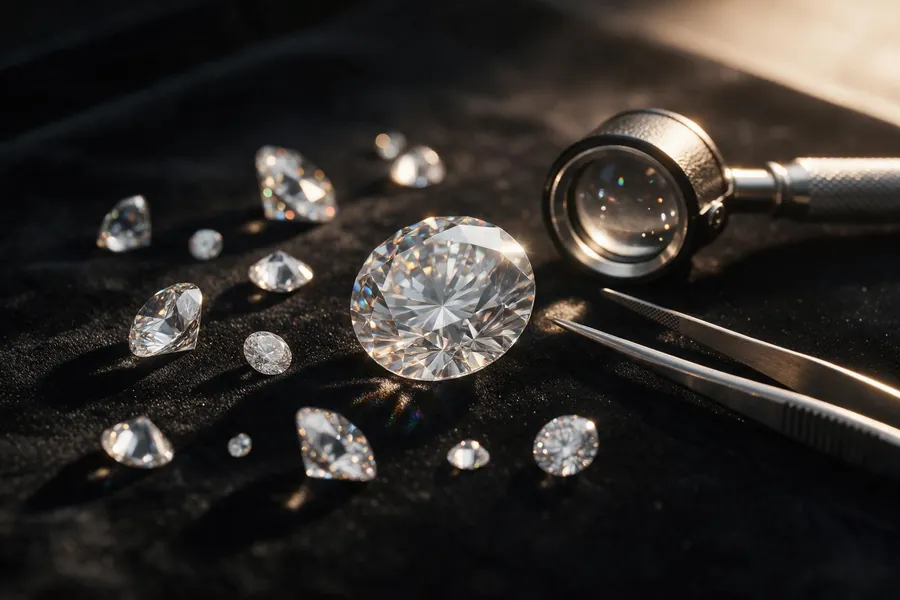
Cut is graded Excellent, Very Good, Good, Fair and Poor for round brilliants, and it describes proportions, symmetry and polish. An Excellent cut returns light through the top of the stone; a Fair cut leaks it out of the sides. This is the grade that decides whether a diamond looks alive. If the budget forces a compromise, take a smaller Excellent stone over a larger Very Good one, every time.
The certificate itself
Insist on a report from GIA, or from IGI for lab-grown stones. The report number is laser-inscribed on the girdle of most stones; a jeweler can show it to you under a loupe so that you know the paper belongs to the diamond in front of you. Read the plotted diagram: it shows where the inclusions sit. A small feather near the edge hides under a prong; a cloud in the centre does not.
Natural or lab-grown
Lab-grown diamonds are chemically identical and cost a fraction of the price, and that price keeps falling. They are a good choice for size and a poor choice for resale, because there is almost no secondary market. If the stone is an heirloom in the making, buy natural. If it is a spectacular pair of studs for everyday wear, lab-grown makes a lot of sense.
Try it yourself
Diamond Price CalculatorCarat, colour, clarity, cut and shape: an indicative retail price range for a natural or lab-grown diamond.Gift FinderWho it is for, the occasion and the budget: five luxury gift ideas that land, from a candle to a watch.Questions people ask
What is the best value diamond grade?
For most buyers a round brilliant with Excellent cut, G to H colour and VS1 to VS2 clarity gives the look of a top stone at roughly half the price of a D flawless.
Does a GIA certificate increase the price?
Slightly, because grading costs money and certified stones are easier to resell. It is worth it: an uncertified stone is priced on trust alone.
Are lab-grown diamonds real diamonds?
Yes. They have the same chemistry and optics as mined stones. The differences are price, resale value and how the stone was made.
Share