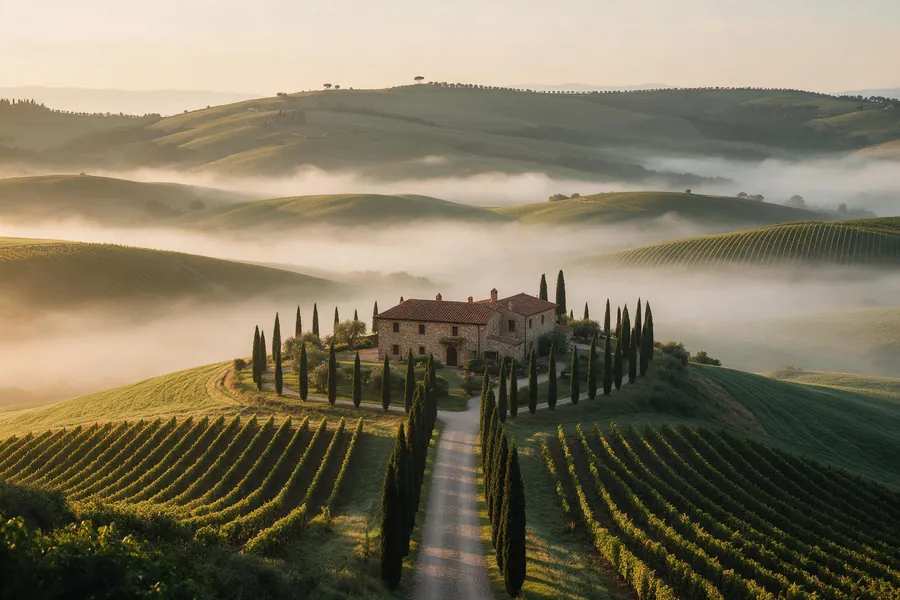

Tuscany is the country-house dream made buyable: farmhouses and castles in Chianti and the Val d’Orcia, wine estates with a name on the label, Florence an hour away and Forte dei Marmi on the coast for the summer. It rewards patience and a good architect.
Stay
- Rosewood Castiglion del Bosco, Val d’Orcia
- Borgo Santo Pietro, near Siena
- Castello di Casole, a Belmond hotel
- Hotel Byron and Augustus, Forte dei Marmi; Four Seasons Florence
Do
- The harvest in Chianti and Montalcino in September and October
- A day in Florence for the Uffizi and the artisans of the Oltrarno
- Lunch at a vineyard in Montalcino with the Brunello
- The beach clubs of Forte dei Marmi in July
- Val d’Orcia at dawn from Pienza
Gavalia’s rules
- A restoration takes two to three years and a good geometra; buy restored unless you enjoy the process.
- Wine estates are valued on the appellation (Brunello di Montalcino, Chianti Classico Gran Selezione) and the cellar, not the villa.
- Forte dei Marmi is the summer: reserved, Italian, expensive and worth it.
Chianti and the Val d’Orcia
The Chianti hills between Florence and Siena hold the restored farmhouses, the castles and the estates that define Tuscany. The Val d’Orcia further south, around Pienza and Montalcino, is the landscape of the postcards: cypress lines, rolling wheat, Brunello vineyards. Rosewood Castiglion del Bosco, Borgo Santo Pietro and Castello di Casole show what an estate can become as a hotel.
Florence
An hour from every estate, the city is the reason many people buy in Tuscany: the museums, the artisans of the Oltrarno, the Four Seasons in its garden, the restaurants. The hills of Fiesole and Bellosguardo above the city hold villas with views that have not changed since the Medici.
Forte dei Marmi
The Versilia coast is where Milan and Florence spend July: bagni with cabanas passed down through families, bicycles, the Byron and the Augustus, villas behind hedges. Prices rival the Amalfi coast; the atmosphere is quieter and entirely Italian.
The property market
Restored farmhouses with land from 2 to 6 million euros in Chianti and the Val d’Orcia; castles and wine estates from 10 million; Forte dei Marmi villas at 10,000 to 20,000 euros per square metre; Florence’s Oltrarno and the hills of Fiesole at 8,000 to 15,000.
Try it yourself
Villa Cost CalculatorPurchase price and country: taxes, fees, annual running costs and the ten-year total, with rental income if you let it.Destination MatcherMonth, mood and budget: the three countries or regions that fit, with the season and the hotels.Questions people ask
Where is the best place to buy a villa in Tuscany?
Chianti for proximity to Florence, the Val d’Orcia for the landscape, Forte dei Marmi for the coast, Lucca and its hills for value.
How much does a Tuscan estate cost?
From about 2 million euros for a restored farmhouse with land to 10 to 40 million for a castle or a working wine estate with a known appellation.
When is the best time in Tuscany?
May and June for green hills and long days, September and October for the harvest, the light and the food.
Share