
Mainspring, gear train, escapement, balance: what actually happens inside a mechanical watch, why finishing is the expensive part and how to read words like in-house, chronometer and power reserve.
In short
- A mechanical movement is a spring, a gear train and a regulator. Everything else is refinement.
- Finishing (anglage, Geneva stripes, black polish) is what separates a 5,000 dollar movement from a 50,000 dollar one.
- Automatic winds itself from your wrist; manual needs winding every day or two. Both are equally accurate.
The four parts
Every mechanical watch does the same thing. A mainspring stores energy when you wind it (or when the rotor of an automatic winds it for you). A gear train transmits that energy and turns the hands. An escapement lets the energy out in tiny, equal steps. A balance wheel, swinging back and forth at a constant rate, controls those steps. That rate, usually 28,800 beats an hour, is what you hear when you hold a watch to your ear.
Why accuracy is not the point
A good mechanical watch drifts a few seconds a day; a cheap quartz watch drifts a few seconds a month. If accuracy were the point, nobody would buy mechanical watches. The point is that a mechanical movement is a machine made of two hundred tiny parts, assembled by hand, that will run for a century if it is serviced. A chronometer certificate (COSC) guarantees minus four to plus six seconds a day; Rolex’s own standard is plus or minus two.
Finishing: the expensive part
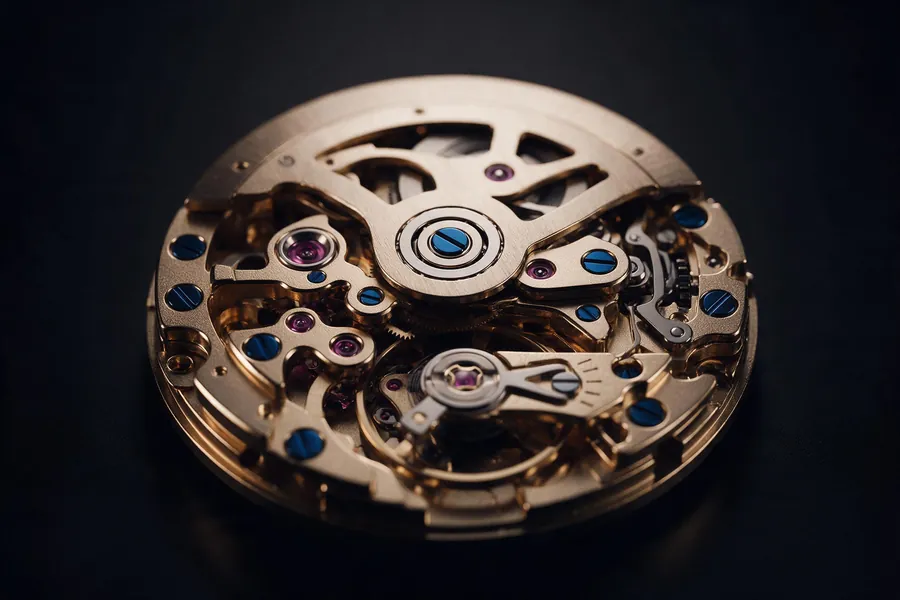
Look at a movement through a sapphire caseback. Bevelled edges polished to a mirror (anglage), striped bridges (Geneva stripes), circular graining on the mainplate, black-polished screws that look either white or black depending on the angle: this is hand finishing, and it is where the hours go. It adds nothing to timekeeping and everything to the price and the pleasure. Patek Philippe, A. Lange & Söhne and Vacheron Constantin are the benchmarks; independents like F.P. Journe and Voutilainen take it further.
In-house, manufacture, calibre
An in-house movement is designed and made by the brand itself. It is a point of pride and a point of marketing. Some of the best movements ever made were supplied by specialists (ETA, Sellita, Valjoux) and finished by the brand. What matters is the quality of the design, the finishing and the servicing network, not the badge.
Complications
Anything beyond hours, minutes and seconds is a complication: date, day, chronograph, GMT, annual calendar, perpetual calendar, moonphase, minute repeater, tourbillon. Each adds parts, cost and service complexity. A perpetual calendar that will not need adjusting until 2100 is a marvel; it is also a watch that needs an expert every five to seven years.
Service
Every five to seven years a mechanical watch needs a service: disassembly, cleaning, fresh lubricants, new gaskets, a pressure test. At a manufacture, expect several hundred to a few thousand dollars depending on the complications. Budget for it; it is the difference between a watch that lasts a lifetime and one that lasts a decade.
Try it yourself
Watch FinderBudget, style, size and how you will wear it: a shortlist of three watches from thirty references, with prices and reasons.Questions people ask
Is an automatic better than a manual watch?
Neither is better. Automatic is more convenient for daily wear; manual is thinner and more engaging to own. Accuracy is the same.
What does in-house movement mean?
A movement developed and produced by the watch brand rather than bought from a specialist supplier. It is a mark of capability, not automatically of quality.
How often should a mechanical watch be serviced?
Every five to seven years, or sooner if it gains or loses time noticeably or if the crown feels rough.
Share