On-demand charter, jet cards, fractional ownership and full ownership compared: hourly costs by aircraft size, the break-even points and the routes where a private jet actually saves time.
In short
- On-demand charter for under 50 hours a year, a jet card for 50 to 100, fractional ownership above 100, full ownership above 250 to 300.
- Light jets from about 6,000 dollars an hour, midsize 8,000 to 10,000, heavy jets 12,000 to 18,000, ultra-long-range 15,000 to 20,000.
- Private aviation saves the most time on routes without direct flights and on multi-city days. On London to New York it saves comfort, not hours.
Four ways to fly
On-demand charter: you book a specific aircraft for a specific trip through a broker or operator. Best for occasional flyers. Jet cards: you buy a block of 25 to 100 hours at a fixed hourly rate with guaranteed availability. Best for 50 to 100 hours a year. Fractional ownership: you buy a share of an aircraft (from one sixteenth upwards) with a monthly management fee and an hourly rate. Best above 100 hours. Full ownership: yours alone, with a crew, a hangar and a management company. Sensible above 250 to 300 hours a year, and even then a form of luxury rather than economics.
What an hour costs
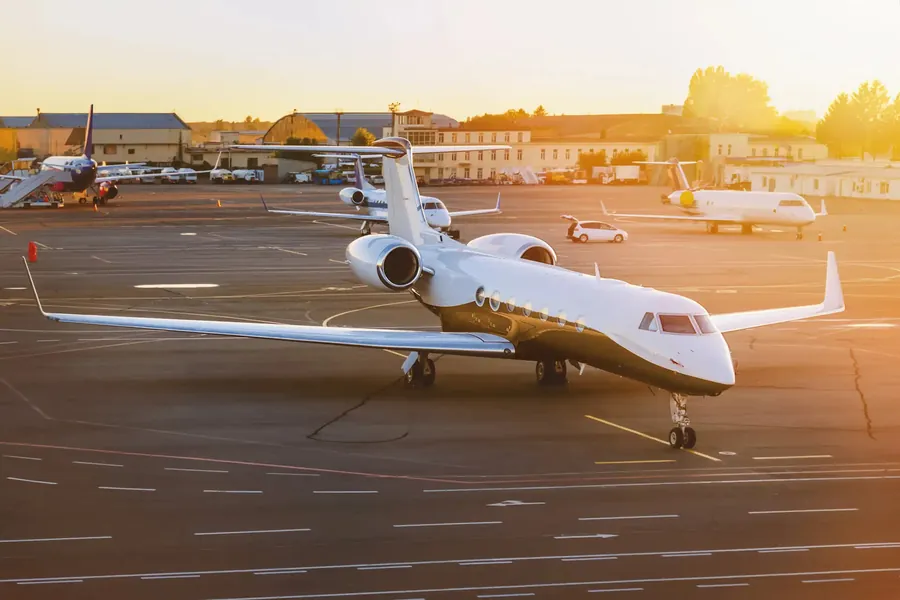
Indicative all-in charter rates: turboprops (Pilatus PC-12) 3,500 to 4,500 dollars an hour; light jets (Phenom 300, Citation CJ4) 5,500 to 7,500; midsize (Citation XLS, Praetor 500) 7,500 to 10,000; super-midsize (Challenger 350, Praetor 600) 9,000 to 12,000; heavy (Challenger 650, Falcon 900, Gulfstream G450) 12,000 to 18,000; ultra-long-range (Gulfstream G650, Global 7500, Falcon 8X) 15,000 to 22,000. Add positioning flights, overnight crew costs, landing fees and, in Europe, VAT.
Where it saves time
A private jet saves real hours on routes without direct commercial service (Munich to Ibiza on a Tuesday, London to a small airfield near a ski resort), on multi-city days (three meetings in three countries, home for dinner) and when a group travels together. On a well-served long-haul route, the saving is mostly at the airport: arrival fifteen minutes before departure, no queues, your car on the tarmac.
Sustainability
Private flying emits far more per passenger than commercial flying. Serious operators offer sustainable aviation fuel (SAF) at a premium and carbon offsetting, and turboprops or light jets on short routes cut the footprint. If it matters to you, ask before you book; the answer tells you about the operator.
How to book well
Use a broker with an operator vetting standard (ARGUS Platinum, Wyvern Wingman) or a large operator (NetJets, VistaJet, Flexjet). Ask for the specific aircraft tail number and its age. Ask what happens if the aircraft goes unserviceable. For jet cards, read the peak-day rules and the fuel surcharge clause; that is where the fine print lives.
The honest summary
For most people who can afford it, a jet card or ad-hoc charter is the rational choice. Ownership is for people who fly constantly or who value having their own aircraft above the arithmetic. Both are legitimate; only one is cheap.
Try it yourself
Luxury Year PlannerTravel, hotels, dining, wardrobe, watches, cars, wellness and gifts: build your luxury year and see the total, then share it.Destination MatcherMonth, mood and budget: the three countries or regions that fit, with the season and the hotels.Questions people ask
How much does it cost to charter a private jet?
From about 5,500 dollars an hour for a light jet to 20,000 for an ultra-long-range aircraft, plus positioning, fees and taxes.
Is a jet card worth it?
For 50 to 100 hours a year, yes: fixed hourly rates, guaranteed availability and no positioning fees within the programme area.
What is fractional jet ownership?
You buy a share of an aircraft, typically from one sixteenth (about 50 hours a year), pay a monthly management fee and an hourly rate, and can fly any aircraft in the fleet.
Share